
Shu Ha Ri: A Framework for Teaching and Mastering Any Skill
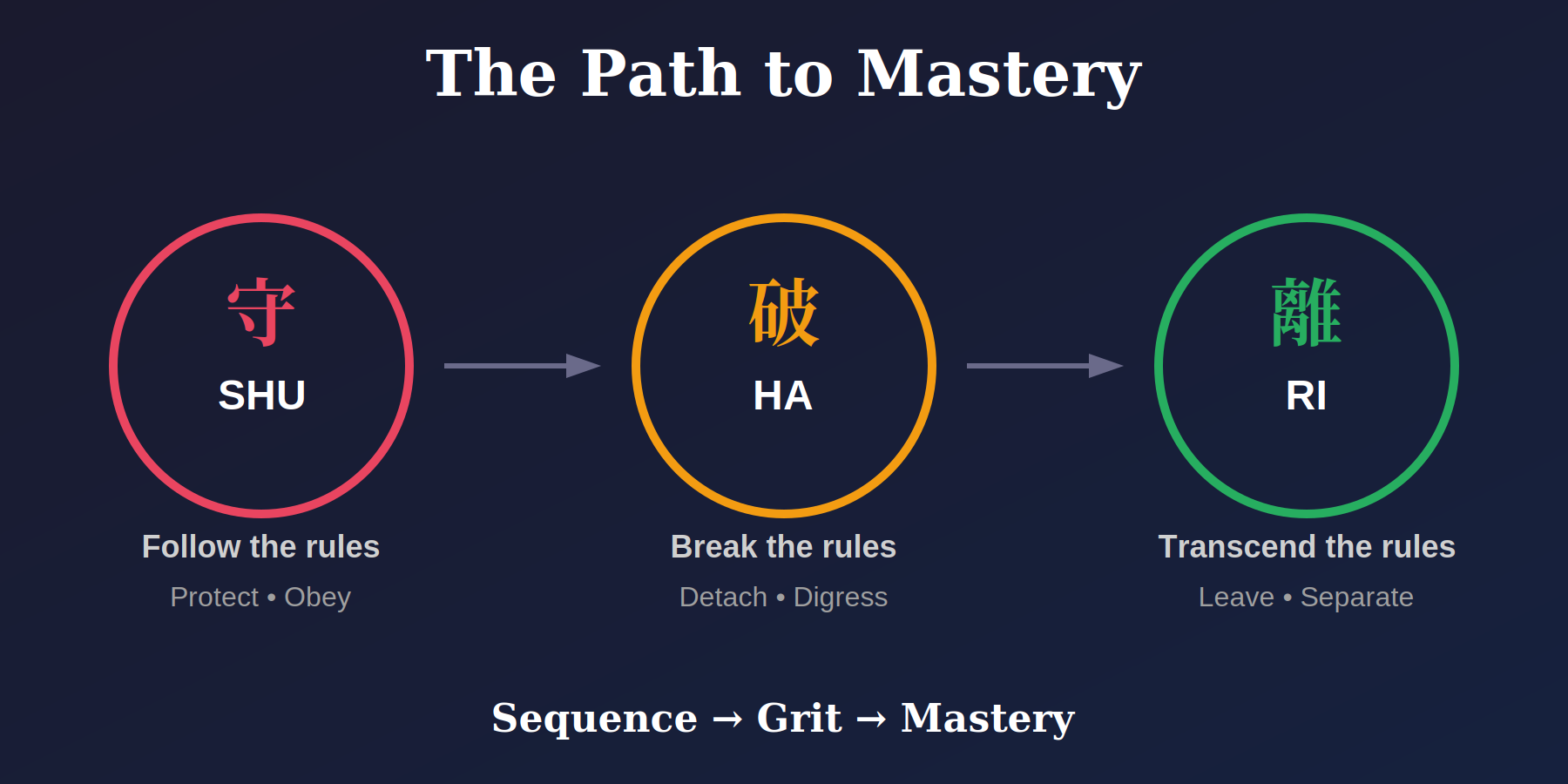
The Shu Ha Ri framework comes from Japanese martial arts. At Genie Academy, we use it to teach students, develop curriculum, and assess knowledge levels.
By understanding its three stages, you can design a training program for any skill — for yourself or your child.
I’ll use the movie “Karate Kid” as an analogy to explain each stage.
The Three Stages
Shu (守) — “protect,” “obey” Ha (破) — “detach,” “digress” — breaking with tradition Ri (離) — “leave,” “separate” — transcendence, where all moves become natural
Stage 1: Shu (Wax On, Wax Off)
Follow the rules. Exactly.
The teacher creates a recipe with the simplest possible steps.
The student follows it precisely. Repeats it until it becomes muscle memory.
In Karate Kid, this is “wax on, wax off.” Mr. Miyagi tells Daniel San: “You promise to learn. I say, you do. No questions.”
What this looks like at Genie Academy:
- Math students memorize times tables, area and perimeter formulas, factorization, LCM and GCF.
- Abacus students memorize Small Buddies, Big Buddies, Combo Buddies, and the Fifty Trick. They practice at least ten minutes of mental math every day.
- Reading students learn phonics and sight words until completely memorized.
- Coding students learn typing first. You can’t code if you can’t type. Then they master basic logic and common syntax. It’s surprising how many computer science students from local universities were never taught this foundation.
If you’re learning to bake bread: Find a simple, precise recipe. Follow it exactly. 400g flour, 300g water, 2g yeast, 10g salt. Mix. Let it rise for 1–3 hours. Bake at 400°F for 30 minutes.
No interpretation. No creativity. Not yet.
I cannot stress this enough.
Mistakes students make:
- They give up too easily
- They question the process
- They don’t believe it will work
Mistakes trainers make:
- They introduce advanced concepts too early
- They assume the student understands underlying fundamentals
- They modify simple lessons based on their own advanced knowledge
This is a fragile time. The student may get bored. They may resist. But you cannot modify the lesson, give up, or let the student give up — not until it becomes muscle memory.
If you’re a skilled practitioner, you must resist using your superior knowledge to make the lesson more complex. You risk confusing the student. They may quit.
This alone explains why so few attain mastery in any skill.
For every kid who learns basketball, there are only a few Michael Jordans or Kobe Bryants.
The student moves to the next stage only when the basics have become muscle memory.
This is a profound insight. I coached a student pilot to solo an airplane using this philosophy alone. No shortcuts. Just structured repetition until the fundamentals were automatic.
Stage 2: Ha (The Break with Tradition)
Now the basics are committed to muscle memory. You can modify the recipe. Introduce variations.
In Karate Kid, Daniel San finally learns why wax on and wax off works.
What this looks like:
- The math student solves complex problems that combine multiple mastered skills.
- The reading student writes complex sentences and paragraphs.
- The writing student composes essays incorporating everything they’ve learned.
- The baker experiments with ingredient ratios and recipe modifications.
Stage 3: Ri (Transcendence)
Now the student transforms. They bend the rules. They create their own methods.
At the climax of Karate Kid, Daniel San is badly injured. He improvises. He creates the Crane Kick — something he was never taught.
What this looks like:
- Genie Academy students pass Gifted and Talented tests, Johns Hopkins CTY tests, or CogAT exams — even when they were never explicitly taught the concepts being tested. The foundation transfers.
- The writing student writes original poetry.
- The baker invents new recipes.
- The coding student builds their own programs and games.
We see Ri-level mastery in professionals every day. We marvel at their ability but can’t duplicate it.
A real example:
My friend Dr. Prakash told me a story from his residency in India. A senior doctor walked past a child in the hallway. One glance. He told the junior doctors to order a Down syndrome test.
They ran the standard tests. No Down syndrome detected.
The next week, the senior doctor returned and asked about the results. When told the tests were negative, he asked them to run a specialized chromosome test.
The child had Down syndrome.
That’s Ri. Pattern recognition so deep it looks like intuition.
Why Masters Often Fail as Teachers
This framework reveals something important: most masters do a poor job training the next generation.
They don’t remember their Shu and Ha stages. They’ve forgotten what it felt like to not know. Their skills have become so natural they can’t break them down into simple terms.
In Zen, this is called Shoshin — beginner’s mind. The expert’s curse is losing it. The great teacher’s skill is returning to it.
If you follow this framework, you can design a training program to teach any skill to anyone — including yourself.
Talent helps. But mastery is sequence and grit. One stage at a time. No skipping. That path is open to anyone willing to walk it.
Topics:
Get A Free Assessment
Sign up or call 732-633-7300 to schedule your free assessment.
Want to make learning this fun every day?
Book a free 60-minute assessment and we'll build a plan for your child.
Get Your Child's Free Assessment

Your child is already curious. Let's channel that.
Genie Academy builds focus, confidence, and a love of learning — math, reading, writing & coding in NJ.
Get Your Child's Free Assessment