
What does math do for a child's brain?
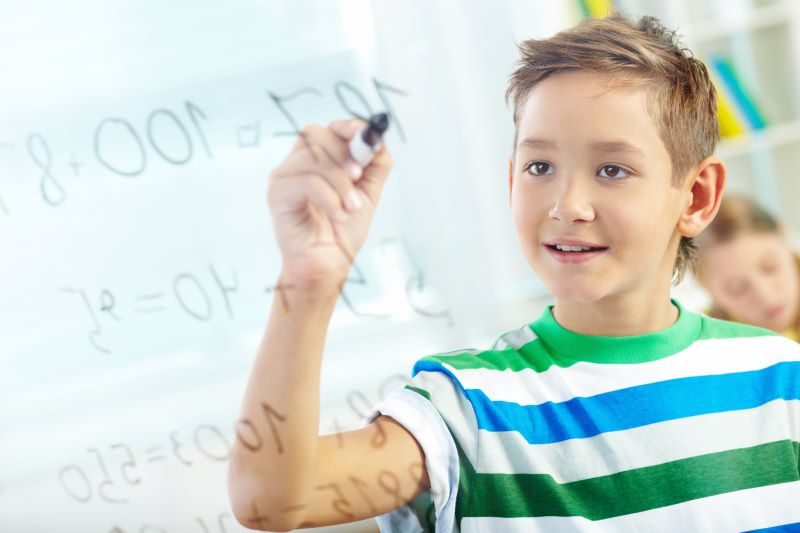
It’s easy to tell a child that doing math is good for them, but what is it that math really does to a child’s brain?
According to a study at Stanford University School of Medicine, “when kids begin processing mental math, the brain reorganizes itself to use its short-term memory center, the hippocampus.” The hippocampus is a small part of the brain that helps transfer information from short-term to long-term memory, and practicing that memory transition early can be helpful decades later.
The same study showed that when children automatically recall simple math facts, there is more room in their brain for new concepts, and they tend to learn new ideas faster than students who haven’t memorized those simple facts. It was shown that children who did mental math or memory recall rather than counting on their fingers were solving problems faster and more accurately, and the same results were found a year and a half later when the same children were reevaluated.
On the other hand, children who frequently counted on their fingers rather than using their memory were found to have less accuracy and speed when answering the same questions.
However, not every child will be able to jump right into mental math. There are many helpful ways to incorporate the steps of mental math using other methods. For example, “building with blocks, using an abacus, making origami, quilting, pattern-making, and copying simple geometric shapes are star contenders for visual-spatial enhancement,” which in turn improves the way math is processed in a child’s brain.
Not only does math help children with their academic achievement, but with their overall success. Understanding concepts like cause and effect, simple operations, and budgeting can help lead your child towards a more successful path. People who do math on a regular basis during and after their teenage years tend to have more neuroplasticity, which is the brain’s ability to change and adapt. Sally Wheale’s Guardian article tells about the Oxford study that showed that these math-inclined people were also likely to show more skill in solving problems, logical reasoning, and learning new concepts than those who had stopped doing math at a younger age.
Math is a necessity that isn’t always obvious in our daily lives, but that every child should know regardless. If your child is struggling with math, schedule a free assessment with us to help them get back on track!
Get A Free Assessment
Sign up or call 732-651-2700 to schedule your free class.
Want to make learning this fun every day?
Book a free 60-minute assessment and we'll build a plan for your child.
Get Your Child's Free Assessment

Your child is already curious. Let's channel that.
Genie Academy builds focus, confidence, and a love of learning — math, reading, writing & coding in NJ.
Get Your Child's Free Assessment