
PEMDAS Explained: A Parent's Guide to the Order of Operations
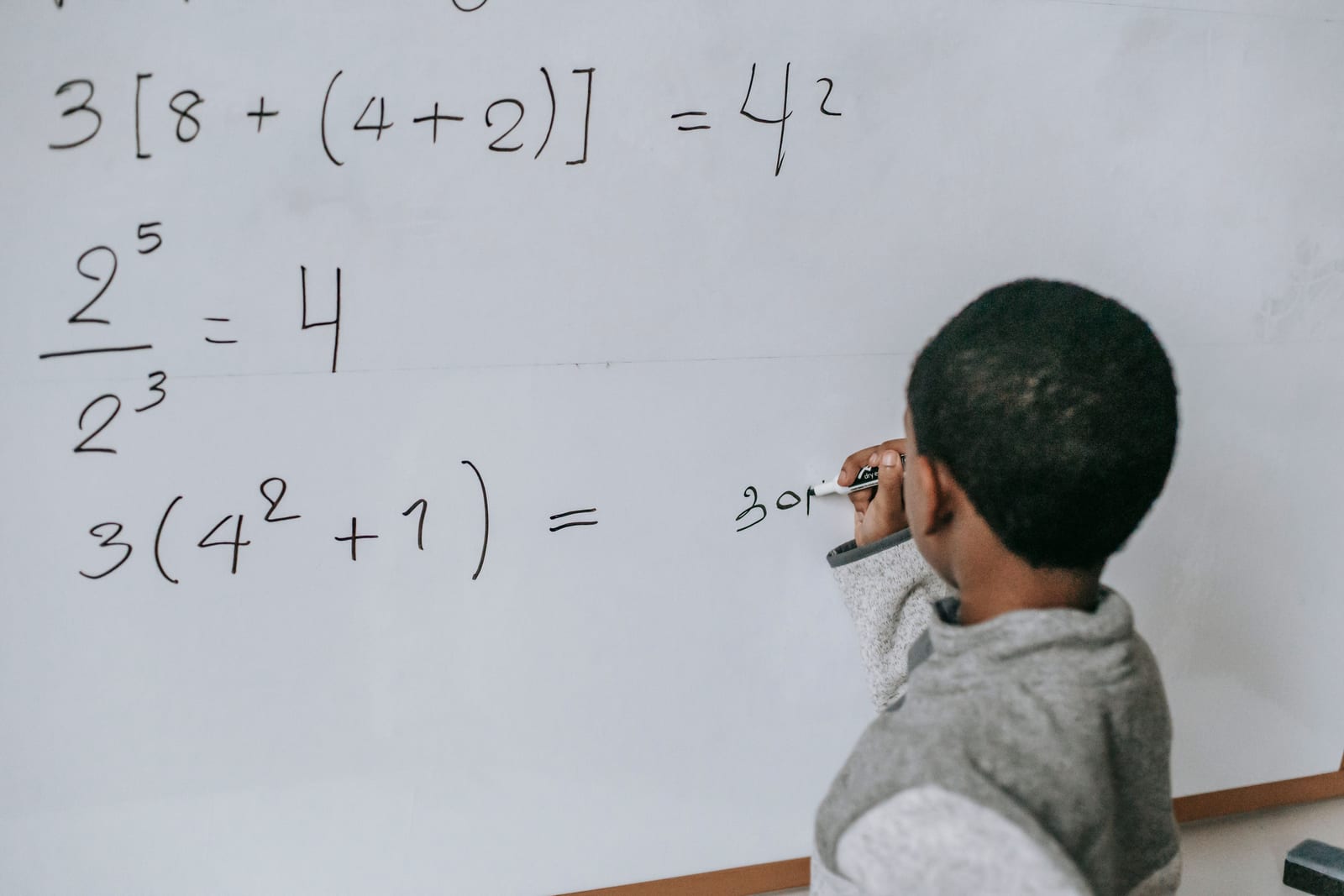
Try this quick problem in your head: 6 + 2 × 3.
If you worked left to right the way we read a sentence, you’d add 6 + 2 to get 8, then multiply by 3, and land on 24. That feels natural — but it’s wrong. The correct answer is 12.
The difference isn’t the numbers. It’s the order you solve them in.
And that order is exactly what PEMDAS is for. Once a child understands it, a whole category of “careless” math mistakes simply disappears.
This guide breaks down what PEMDAS means, the one rule that trips up almost everyone, and a few simple ways you can help your child master it at home.
What Is PEMDAS?
PEMDAS is a rule that tells you the order in which to solve the different parts of a math problem. Each letter stands for a step:
- P — Parentheses
- E — Exponents
- M — Multiplication
- D — Division
- A — Addition
- S — Subtraction
Most students learn it with the mnemonic “Please Excuse My Dear Aunt Sally.” It’s silly, which is exactly why it sticks.
Children typically meet the order of operations around 5th grade and rely on it through middle school, high school algebra, and well beyond. It’s one of those foundational skills that quietly shows up in almost every math problem they’ll ever do.
The Order, Step by Step
When your child looks at a math problem, here’s the order to work through it:
- Parentheses first. Solve anything inside parentheses (or other grouping symbols) before touching the rest.
- Exponents next. Handle any powers, like 3².
- Multiplication and Division — working left to right.
- Addition and Subtraction — working left to right.
That last detail — “left to right” — is where most of the confusion lives. So let’s slow down on it.
The Mistake Almost Everyone Makes
Here’s the trap hidden inside PEMDAS: the letters make it look like multiplication always comes before division, and addition always comes before subtraction. It doesn’t.
Multiplication and division are equal partners. So are addition and subtraction. When you reach that stage, you don’t do all the multiplying first — you simply work from left to right, taking each one as it comes.
Look what happens if you ignore that:
12 ÷ 4 × 2
- Correct (left to right): 12 ÷ 4 = 3, then 3 × 2 = 6
- Wrong (multiplication first): 4 × 2 = 8, then 12 ÷ 8 = 1.5
Same problem, two very different answers — and only one is right.
If your child remembers nothing else, this is the rule worth burning in: when operations are tied, go left to right.
Worked Examples (Easy to Hard)
The best way to build confidence is to watch the steps unfold one line at a time. Here are four examples, from simple to multi-step.
Example 1 — Multiplication before addition
8 + 2 × 5 = 8 + 10 (multiply first) = 18
Example 2 — Parentheses change everything
(8 + 2) × 5 = 10 × 5 (parentheses first) = 50
Notice that Examples 1 and 2 use the exact same numbers — the parentheses are the only difference, and they completely change the answer.
Example 3 — Bringing in exponents
4 + 3² × 2 = 4 + 9 × 2 (exponent first) = 4 + 18 (then multiply) = 22
Example 4 — Putting it all together
(6 + 4) ÷ 2 + 3² = 10 ÷ 2 + 3² (parentheses) = 10 ÷ 2 + 9 (exponent) = 5 + 9 (divide) = 14
Encourage your child to rewrite the entire problem on each new line, changing only one thing at a time. It feels slower, but it prevents the rushed errors that cost points on tests.
Common Mistakes Kids Make
When a problem comes back marked wrong, it’s usually one of these:
- Doing multiplication before division (or addition before subtraction) instead of working left to right.
- Forgetting that a number next to parentheses means multiply — for example, 3(4) means 3 × 4.
- Skipping exponents and treating 3² as 3 × 2 instead of 3 × 3.
- Rushing the whole thing in one step instead of writing out each stage.
None of these mean a child is “bad at math.”
They’re sequencing slips — and sequencing is a skill that improves quickly with the right practice.
How to Help Your Child Practice at Home
You don’t need to be a math expert to help. A few small habits go a long way:
- Rewrite one step at a time. Ask your child to copy the whole problem on each line and change only one operation. Neat work means fewer mistakes.
- Underline what comes first. Before solving, have them circle the parentheses or underline the step they’ll tackle first. It turns “order” into something visible.
- Ask “why,” not just “what.” Instead of checking only the answer, ask why they did that step first. Explaining it out loud cements the rule.
- Keep it short and positive. Five focused minutes beats a frustrating half hour. Celebrate the correct process, even when the final number slips.
When Your Child Keeps Struggling — and How Genie Academy Can Help
If the order of operations keeps tripping your child up, you’re not alone — and it isn’t a sign they “can’t do math.” Order of operations is a sequencing skill layered on top of arithmetic, and plenty of capable students need extra practice to make it automatic. The good news is that it’s very teachable with the right structure.
At Genie Academy, our math tutors start by pinpointing exactly where the confusion lives, then build a personalized lesson plan to fix it. With small class sizes of no more than six students, your child gets the individual attention that turns shaky guesses into confident, step-by-step problem solving — a foundation that pays off all the way through algebra and beyond.
Curious where your child stands? Schedule a free assessment and we’ll evaluate their math skills, show you their strengths and gaps, and recommend a clear path forward — with no obligation.
Frequently Asked Questions
What does PEMDAS stand for? PEMDAS stands for Parentheses, Exponents, Multiplication, Division, Addition, and Subtraction — the order in which you solve the parts of a math problem.
Do you always do multiplication before division? No. Multiplication and division are equal in rank, so you work them from left to right in the order they appear. The same is true for addition and subtraction.
What grade do kids learn the order of operations? Students are usually introduced to the order of operations in 5th grade (Common Core standard 5.OA.A.1) and continue using it throughout middle school, high school, and beyond.
Want to make learning this fun every day?
Book a free 60-minute assessment and we'll build a plan for your child.
Get Your Child's Free Assessment


Your child is already curious. Let's channel that.
Genie Academy builds focus, confidence, and a love of learning — math, reading, writing & coding in NJ.
Get Your Child's Free Assessment