
1st Grade Math: Every Topic and Skill Explained
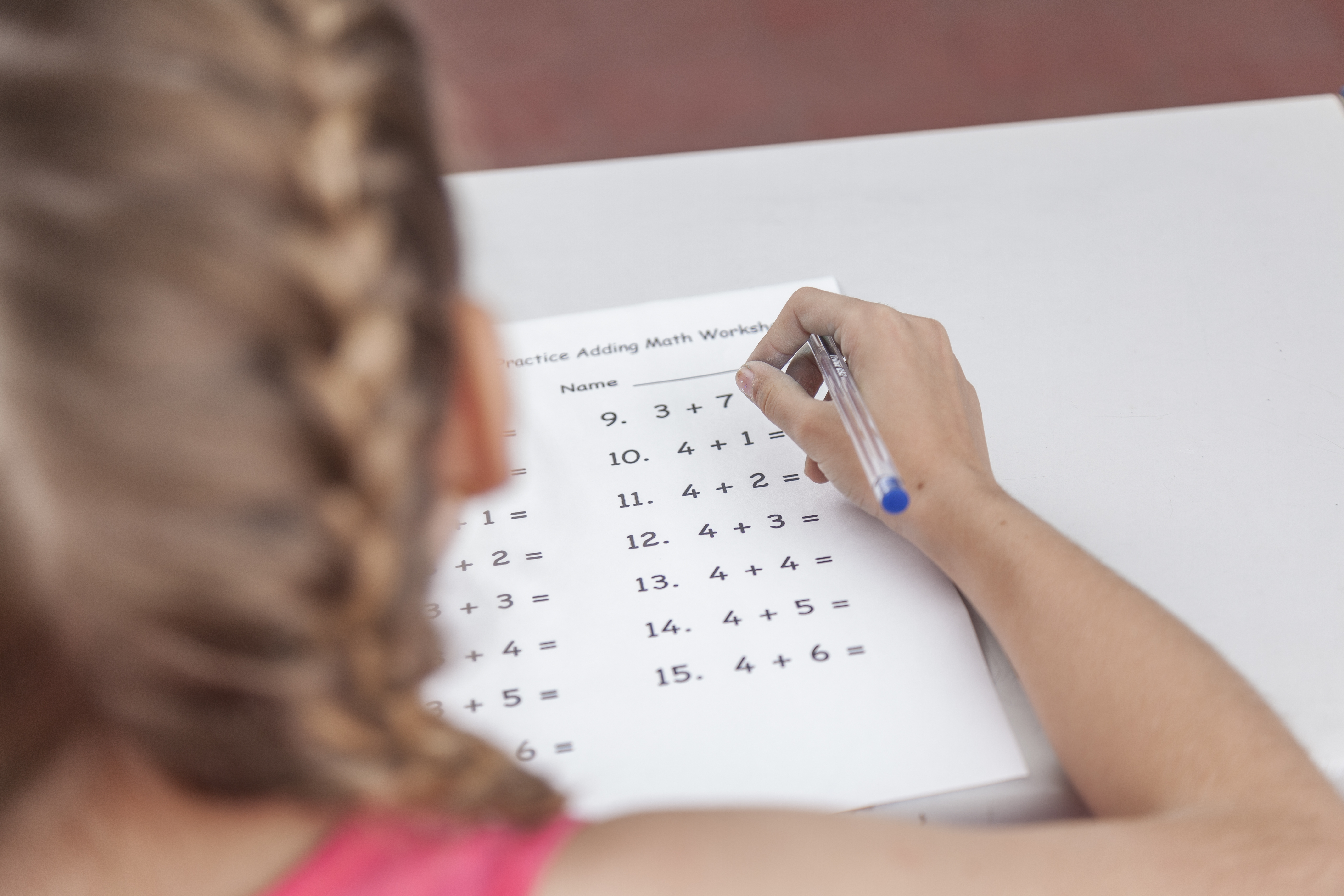
By first grade, math changes fast. Your child goes from counting objects to solving real problems — adding, subtracting, comparing numbers, telling time. If you’ve ever looked at a worksheet and wondered what’s actually being taught, or whether your child is keeping up, you’re in good company. Almost every parent wonders the same thing.
So here’s a plain-English walk through everything first graders learn in math this year: what each skill looks like, why it matters, and small ways to help at home. The year’s math falls into a handful of connected areas — addition and subtraction, counting and place value, measurement and time, data, and shapes. Let’s take them one at a time.
Addition and Subtraction Within 20
This is the heart of first grade. Your child builds from adding and subtracting within 10 to doing it fluently within 20.
The big shift this year is from numbers to stories. Your child learns to solve word problems — “adding to,” “taking from,” “putting together,” and “comparing” — like “There were 7 birds, 3 flew away, how many are left?” Figuring out what the story is asking is often harder than the arithmetic itself.
Along the way they pick up real strategies: counting on from the bigger number, making a ten, using doubles (6 + 6), and fact families (knowing that 4 + 3 = 7 means 7 − 3 = 4).
Two ideas quietly matter a lot here:
- The equal sign means “the same as,” not “the answer comes next.” Your child will see problems written as 6 = 4 + 2, which can look backwards until it clicks.
- Finding the missing number, like 8 + __ = 11. This sets up algebra years down the road.
At home: Ask “how many more?” questions at the dinner table, or play fast fact games in the car. Keep it light — a few minutes often beats a long worksheet.
Counting and Place Value (Numbers to 120)
First graders count, read, and write numbers all the way to 120 — and they learn to start counting from any number, not just from one.
The key concept is place value: understanding that in 34, the 3 means three tens and the 4 means four ones. This is the foundation for every bigger number your child will ever work with.
From there they learn to:
- Compare two-digit numbers using greater than, less than, and equal to (the >, <, and = symbols).
- Add within 100 (a two-digit number plus a one-digit number, or plus a ten).
- Mentally find 10 more or 10 less than a number — without counting one by one.
- Subtract multiples of ten, like 50 − 20.
At home: Count real objects in groups of ten (cereal pieces, coins, blocks). Point out numbers on signs, receipts, and house addresses, and ask which is bigger.
Measurement and Time
Your child starts measuring the world and reading a clock.
For length, they compare and order objects (which is longer, shorter, tallest) and measure using same-size units — like lining up paper clips or cubes end to end.
For time, they learn to tell and write time to the hour and the half-hour, on both analog and digital clocks. That little half-past hand throws a lot of kids at first, so don’t worry if it takes practice.
At home: Ask “which is longer?” comparisons around the house, and read the clock together at daily routines (“it’s 7:30, time for bed”).
Data and Graphs
First graders get their first real taste of working with information. They organize and sort objects into up to three categories, then read simple picture graphs and tally charts.
The goal is answering questions from the data: how many in each group, and how many more or fewer one group has than another.
At home: Sort and chart something real — types of toys, colors of cars that drive past the window, favorite fruits in the family. Then ask a “how many more?” question about it.
Geometry and Shapes
Shapes become more than just names this year. Your child learns to tell defining attributes from the rest — a triangle has three sides no matter its color, size, or which way it’s turned.
They also learn to:
- Build and combine 2D and 3D shapes (rectangles, squares, circles, cubes, cones) to make new ones.
- Split shapes into halves and fourths — the very first taste of fractions.
At home: Go on a shape hunt around the house, and cut a snack or a piece of paper into equal parts while talking about halves and quarters.
How These Skills Build on Each Other
Here’s the part that’s easy to miss: none of this stands alone. Place value is what makes bigger addition possible. Halves and fourths quietly set up fractions in third and fourth grade. And every word problem your child wrestles with now is training the reasoning they’ll use all through elementary school.
First grade math isn’t really about any single skill. It’s the foundation everything later stands on.
Signs Your Child May Need a Little Extra Support
Every child moves at their own pace, but a few patterns are worth watching for as the year goes on:
- Still counting on fingers for every small fact late in the year.
- Guessing on word problems instead of working out what’s being asked.
- Confusion about which of two numbers is bigger.
- Frustration, tears, or avoidance whenever math homework appears.
If any of these sound familiar, take a breath — they’re common, and they’re very fixable with the right, patient practice. They’re a signal, not a verdict.
How to Help at Home
You don’t need to be a math teacher. A few simple habits go a long way:
- Keep it short and playful. Ten focused minutes beats an hour of resistance.
- Talk math out loud during everyday moments — cooking, shopping, setting the table.
- Focus on understanding, not speed, especially early on. Fast comes later.
- Praise the effort and the strategy, not just the right answer.
You’ve Got This — and So Does Your Child
The goal of first grade math isn’t perfection. It’s confidence and a solid foundation your child can build on for years. Some skills will click right away; others will take a few tries. Both are completely normal.
If your child could use extra support — or you’d just like to know exactly where they stand — a program like Genie Academy’s math and abacus tutoring builds these foundational skills step by step, at your child’s own level and pace.
Get A Free Assessment
Sign up or call 732-659-4364 to schedule your free assessment.
For a longer walk through the same year, see our full guide to what 1st graders learn in math. And when you’re ready for what comes next, here’s what your child learns in 2nd grade math.
Frequently asked questions
What math do kids learn in 1st grade?
First grade math falls into a handful of connected areas: addition and subtraction within 20 (including word problems), counting and place value with numbers to 120, measurement and telling time to the hour and half-hour, sorting data into simple graphs, and shapes, including splitting them into halves and fourths.
What is the most important 1st grade math skill?
Addition and subtraction within 20 is the heart of first grade. Your child builds from adding and subtracting within 10 to doing it fluently within 20, and learns to solve word problems by figuring out what the story is asking. Place value, knowing that in 34 the 3 means three tens and the 4 means four ones, is the other big foundation.
How do I know if my 1st grader needs extra help in math?
Watch for a few patterns as the year goes on: still counting on fingers for every small fact late in the year, guessing on word problems instead of working out what's being asked, confusion about which of two numbers is bigger, and frustration, tears or avoidance whenever math homework appears. They're common, and very fixable with the right, patient practice.
How can I help my 1st grader with math at home?
Keep it short and playful, since ten focused minutes beats an hour of resistance. Talk math out loud during everyday moments like cooking, shopping and setting the table. Focus on understanding, not speed, and praise the effort and the strategy, not just the right answer.
Want to make learning this fun every day?
Book a free 60-minute assessment and we'll build a plan for your child.
Get Your Child's Free Assessment
Your child is already curious. Let's channel that.
Genie Academy builds focus, confidence, and a love of learning — math, reading, writing & coding in NJ.
Get Your Child's Free Assessment