
8th Grade Math in New Jersey: Honors Placement & Algebra Readiness

If your child is heading into 8th grade math, you may already be hearing new words come home — functions, slope, systems of equations — and wondering when arithmetic turned into algebra.
You’re not imagining it. 8th grade is the year math starts to feel more abstract, and for a lot of parents that’s when the worry sets in.
Here’s the reassuring part: this is a bridge year, not a cliff. It’s where your child moves from working with numbers to reasoning with relationships — the exact thinking that high school math is built on. With the right support, 8th grade is where many kids find their confidence rather than lose it.
Why This Year Carries Extra Weight in New Jersey
8th grade math does two jobs at once. It wraps up the middle school curriculum, and it sets your child up for Algebra I — the first real gateway course in high school.
In New Jersey, that second job has consequences. Many districts look at 8th grade performance when deciding high school math placement, including whether a student lands in an honors or accelerated track. The pace also shifts: there are fewer topics than in earlier grades, but each one goes deeper and builds on the last.
If you want your child to make it into a Magnet high school, this is the time to focus in on making sure they are confident with the material in 8th grade.
That is the part parents tend to find out late. A child can drift through 7th grade with small gaps and no visible consequence. In 8th grade the same gaps meet a placement decision.
What “Ready for Algebra I” Actually Means
Placement conversations tend to happen in the language of tracks and courses. Underneath, they come down to a handful of skills:
- Linear equations — solving for a variable, handling equations with variables on both sides, and making sense of what it means when an equation has no solution or infinitely many.
- Slope and rate of change — reading it from a graph, pulling it from a table, and recognising it inside an equation. Underneath the vocabulary, slope is just answering a real question: how fast is something changing?
- Functions — where it all comes together, as students learn that an equation, a table, and a graph are three different views of the same relationship.
These aren’t isolated skills. They’re the literal building blocks of Algebra I, which is why gaps here tend to compound quickly if they aren’t caught.
For the full topic list — the number system, geometry, statistics and everything else your child covers this year — see 8th Grade Math Topics: What Kids Learn & How to Help.
The Confidence Dip, and Why It Isn’t What You Think
The most common surprise for parents is the confidence dip. A child who’s always been strong at arithmetic can suddenly stumble when math turns abstract.
That’s normal, and it doesn’t mean your child isn’t good at math.
A few spots trip kids up most often:
- Working with negative numbers and exponents
- Keeping an equation balanced while solving it
- Making the leap from concrete numbers to variables
There are signs your child may need a little extra support, including avoiding math homework, saying “I get it in class but freeze on the test,” slipping grades, or a noticeable drop in confidence.
The reason this matters more in 8th grade than in other years is timing. A dip in 6th grade costs a few rough weeks. A dip in 8th grade can land in the window where a placement decision is being made.
How to Support Your Child at Home
You don’t need to remember how to solve for x to be a huge help.
- Ask your child to explain a problem to you instead of quizzing them. Teaching it out loud is where understanding shows up. When a student can teach you what they’ve learned, you see the application. Ask questions as if you don’t know how to solve anything — watching how they walk you through it is an excellent way to see where they’re getting stuck.
- Connect math to real life: budgeting, sports stats, doubling a recipe. If your child has a particular interest in sports, this can be a great way for things to stick. Make it feel real for them, not so abstract.
- Watch for older gaps that resurface, especially with fractions and integers. It comes back to filling the missing bricks — if there are concepts from early middle school your child is still struggling with, make sure they understand the foundation before building on it.
- Praise the effort and the reasoning, not just the right answer. With the right kind of encouragement a child can do anything. Kids become more intrinsically motivated when they realise what matters most is their effort, not solely their results.
How Genie Academy Helps
At Genie Academy, we teach the why behind every skill, not just one method to memorise. Small classes mean your child gets the attention to catch gaps before they turn into bigger problems, and our coaches build confidence right alongside the content — so your child walks into high school math ready for whatever comes next.
8th grade math is challenging. It’s also one of the best opportunities your child will get to set themselves up for success in high school.
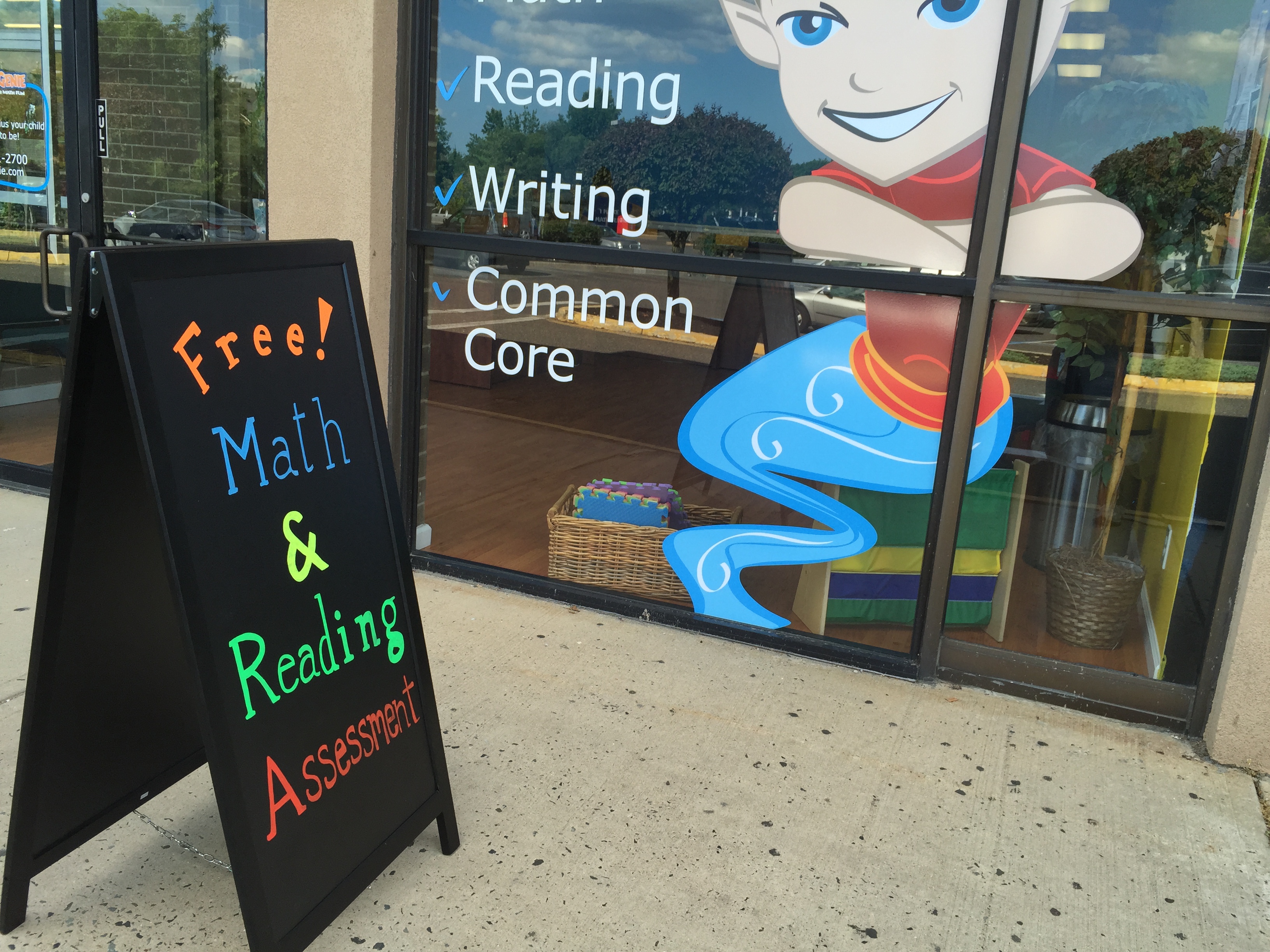
Get a Free Assessment
Sign up for a free assessment or call 732-633-7300 to schedule your free assessment and see exactly where your child stands.
Frequently asked questions
Why does 8th grade math matter for high school placement in New Jersey?
Many New Jersey districts look at 8th grade performance when deciding high school math placement, including whether a student lands in an honors or accelerated track. If you are hoping your child makes it into a Magnet high school, this is the year to focus on making sure they are confident with the material.
Why is my child suddenly struggling in 8th grade math?
The most common surprise for parents is the confidence dip: a child who has always been strong at arithmetic can stumble when math turns abstract. That is normal and does not mean your child isn't good at math. The spots that trip kids up most often are working with negative numbers and exponents, keeping an equation balanced while solving it, and making the leap from concrete numbers to variables.
What are the signs my 8th grader needs math help?
Watch for avoiding math homework, saying "I get it in class but freeze on the test," slipping grades, or a noticeable drop in confidence. Older gaps resurfacing — especially with fractions and integers — are worth catching early, because 8th grade material builds directly on them.
How can I help my 8th grader with math at home?
Ask your child to explain a problem to you instead of quizzing them — teaching it out loud is where understanding shows up. Connect math to real life through budgeting, sports stats or doubling a recipe. Watch for older gaps resurfacing, especially fractions and integers. And praise the effort and the reasoning, not just the right answer.
Want to make learning this fun every day?
Book a free 60-minute assessment and we'll build a plan for your child.
Get Your Child's Free Assessment

Your child is already curious. Let's channel that.
Genie Academy builds focus, confidence, and a love of learning — math, reading, writing & coding in NJ.
Get Your Child's Free Assessment