
Fewer Than Half of NJ 4th Graders Read at Grade Level
Your child brings home decent grades. Reading time at night goes fine — mostly. But every so often you catch something that gives you pause: they skip the tricky words, or they finish a page and can’t quite tell you what just happened.
You wonder if they’re really reading, or just getting by.
If that sounds familiar, you’re far from alone.
I’ve seen it with my own students. They’ve somehow skated through school with gaps that gradually increase and catch up with them as they move up another year. Soon enough they’re behind, and that’s when parents bring them in for support.
Most NJ Kids Aren’t Reading at Grade Level
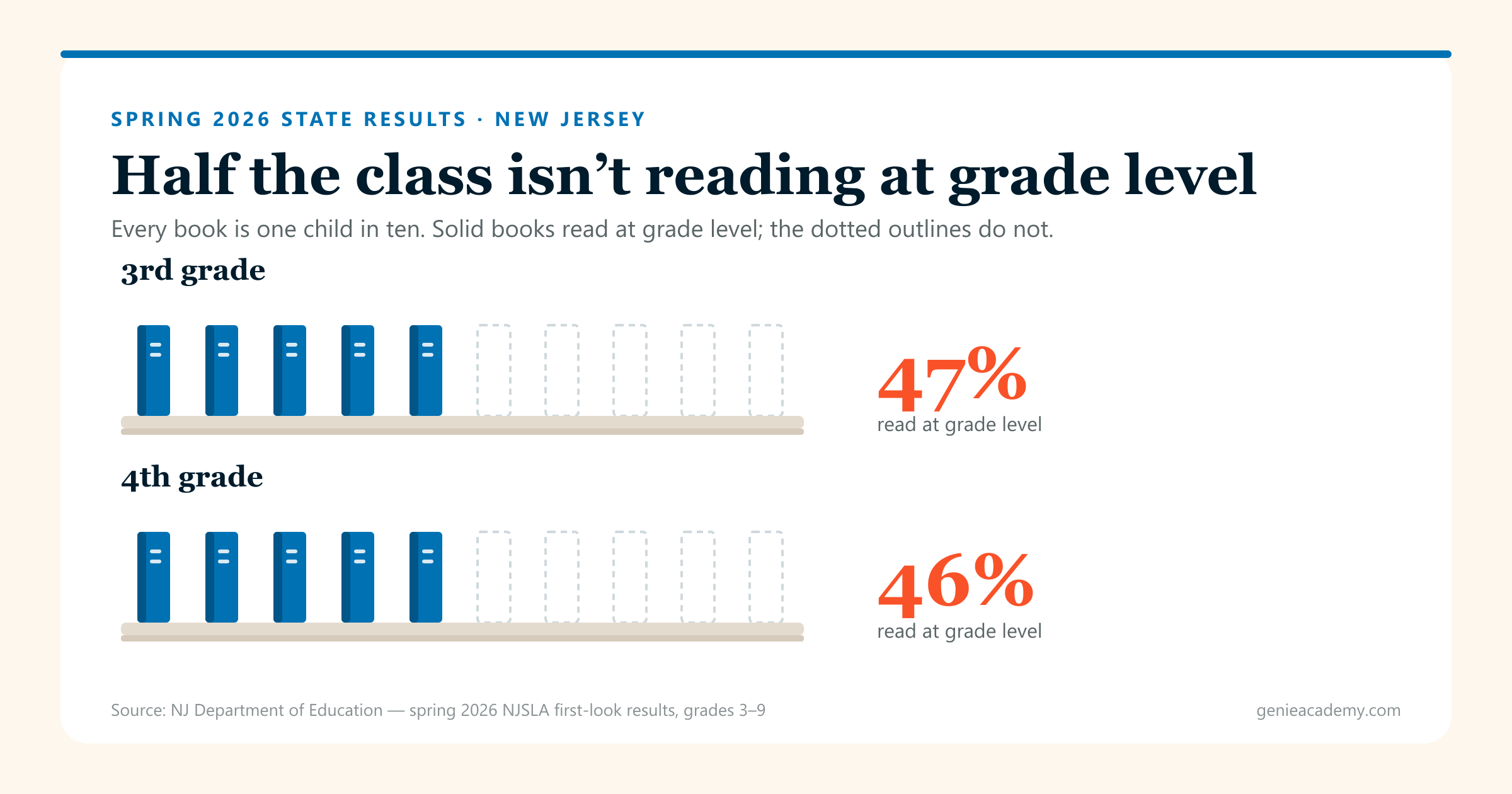
The newest state test results tell a hard story. On the spring 2026 assessments, only about 47% of New Jersey third graders were reading at grade level. Fourth grade was slightly worse, at 46%.
That means about half of children in both grades aren’t where the standards say they should be — and these numbers have hovered below the halfway mark for years.
It’s easy to read a statistic like that and assume it’s about “other” schools.
It isn’t. This is a statewide pattern, in strong districts and struggling ones alike. As a coach working across the South Brunswick and Plainsboro areas, I can tell you it’s happening everywhere. The district doesn’t change it.
Why Third and Fourth Grade Matter More Than Any Other Years
There’s a shift that happens around this age that most parents never hear about: children stop learning to read and start reading to learn.
Through third grade, reading itself is the lesson. From fourth grade on, reading becomes the tool for everything else — the science chapter, the word problem in math, the directions on a test. Teachers stop slowing down to help children decode words, because by then they assume the words are easy.
So if your child hasn’t fully locked in reading by fourth grade, they don’t just fall behind in English. They start slipping in every subject at once — and often nobody connects it back to reading.
That’s what makes these two grades a quiet turning point. Caught early, a reading gap is very fixable. Left alone, it compounds.
Why Good Report Cards Can Hide a Reading Problem
Here’s the tricky part: a child can earn A’s and B’s and still be behind in reading.
Children are resourceful. They lean on memory, picture clues, classroom routines, and guessing from the first letter of a word. It’s genuinely impressive — they use inference to work out as much as they can. And it works well enough to pass, right up until the reading gets harder and the scaffolding falls away, usually around fourth or fifth grade.
A few signs worth watching for at home:
- They avoid reading out loud, or go quiet when it’s their turn.
- They read slowly, word by word, instead of in smooth phrases.
- They can sound out a sentence but can’t tell you what it meant.
- They resist new or longer books and stick to ones they’ve memorised.
- They guess at words from the first letter instead of reading all the way through.
None of these mean something is wrong with your child. Quite the opposite — it means they aren’t getting enough support for one specific skill. And that’s good news, because specific skills can be taught.
I’ve worked with children almost three grade levels behind in reading, and they have always been able to catch up. The younger they are, the easier it is to unlearn and relearn. The advice I’d give any parent is simple: seek academic support sooner rather than later.
What Actually Helps at Home
A few consistent habits do more than any app:
- Have your child read to you, not just silently. You can’t help with a struggle you never hear.
- Ask “what happened, and why?” after a few pages. Comprehension is the whole point, not just getting the words out.
- Keep sounding-out alive. Phonics isn’t just for kindergarten — it’s the engine of reading, and New Jersey schools are leaning back into it for a reason.
- Let them re-read their favourites. Repetition builds the fluency that makes reading feel easy.
- Pick books a notch too easy sometimes. Confidence is fuel. A small win at bedtime keeps a reluctant reader reading, and building that confidence early stops a child giving up before they’ve really started.
Fifteen honest minutes a day, most days, beats an hour once a week.
When Home Effort Isn’t Enough
Sometimes a child keeps struggling no matter how consistent you are. That usually means the gap sits in one specific place: decoding the words, reading them smoothly, or understanding what they read. Each needs a different fix, and it’s genuinely hard to tell which is which from the outside.
That’s where a real diagnosis helps. Not generic “reading tutoring,” but working out where reading broke down and building from exactly there.
At Genie Academy, that’s where we start. Every child begins with an assessment, so instruction targets the actual gap — in small groups where a teacher can hear each child read and respond in the moment.
The Takeaway
The state scores are frightening to me as an educator. But they aren’t a verdict on your child.
A reading gap noticed in third or fourth grade is one of the most fixable problems in a child’s education. The danger isn’t the gap — it’s the gap nobody catches.
If you’re not sure where your child stands, find out. That’s the whole first step.
Frequently asked questions
What percentage of New Jersey 4th graders read at grade level?
On the spring 2026 state assessments, about 46% of New Jersey fourth graders were reading at grade level, and about 47% of third graders. That means roughly half of children in both grades are not where the standards say they should be, and these figures have hovered below the halfway mark for years.
Can my child get good grades and still be behind in reading?
Yes. Children are resourceful — they lean on memory, picture clues, classroom routines and guessing from the first letter of a word. That works well enough to pass, until the reading gets harder and the scaffolding falls away, usually around fourth or fifth grade. A report card measures classroom performance, not whether the underlying reading skill is secure.
What are the signs my child is struggling with reading?
Watch for a child who avoids reading out loud, reads slowly word by word instead of in smooth phrases, can sound out a sentence but cannot tell you what it meant, resists new or longer books in favour of ones they have memorised, or guesses at words from the first letter instead of reading all the way through.
Why do third and fourth grade matter so much for reading?
Around this age children stop learning to read and start reading to learn. Through third grade, reading itself is the lesson. From fourth grade on, reading becomes the tool for every other subject — the science chapter, the word problem, the directions on a test. Teachers stop slowing down to help decode words because they assume the words are already easy, so a child who has not locked in reading starts slipping in every subject at once.
Is a reading gap fixable?
Caught early, yes — it is one of the most fixable problems in a child's education. Children who are nearly three grade levels behind can catch up. The younger they are, the easier it is to unlearn and relearn, which is why seeking support sooner rather than later matters so much.
Want to make learning this fun every day?
Book a free 60-minute assessment and we'll build a plan for your child.
Get Your Child's Free Assessment


Your child is already curious. Let's channel that.
Genie Academy builds focus, confidence, and a love of learning — math, reading, writing & coding in NJ.
Get Your Child's Free Assessment