
New Jersey Is Ranked #1 for Education. Only 22.5% of 8th Graders Can Do Grade-Level Math.
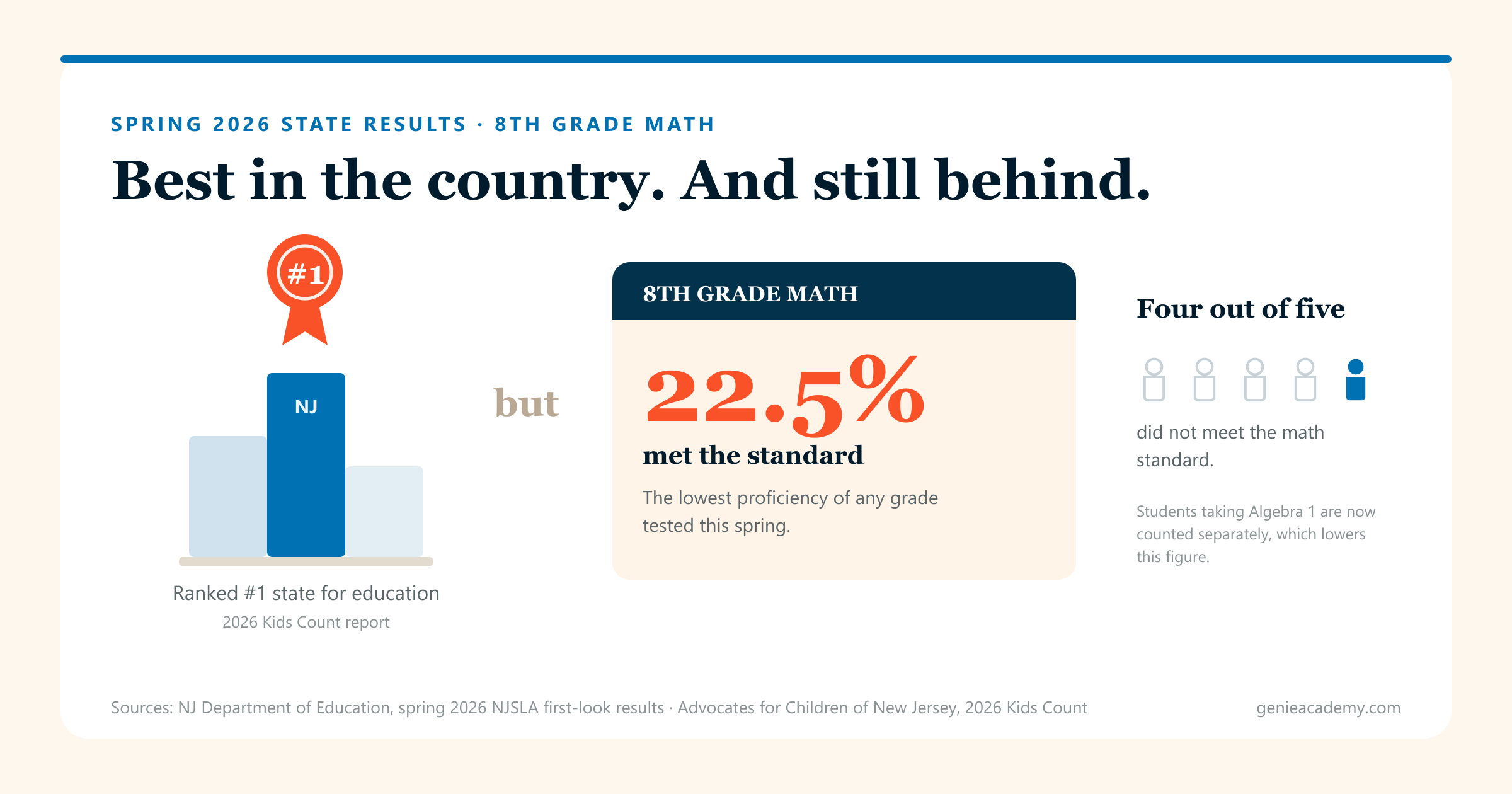
New Jersey was just ranked the #1 state in the country for education.
On the same spring 2026 tests, 22.5% of its eighth graders met the math standard.
If that combination sounds impossible, it’s because the ranking hides something every parent should see: in one of the best school systems in America, most children still aren’t meeting the standard.
How “We’re #1” and “Most Kids Are Behind” Can Both Be True
It sounds like a contradiction. It isn’t.
Rankings compare states to each other. New Jersey looks strong mostly because schools everywhere are struggling — so “best in the nation” can still mean most children aren’t proficient. Being academically strong, it turns out, is entirely relative.
Mary Coogan of Advocates for Children of New Jersey made the point plainly: instead of celebrating the ranking, the state should start “comparing ourselves against ourselves” — are our children doing better than they were, or worse?
For a parent, the takeaway is simpler still. A statewide ranking tells you nothing about your child. Averages hide individual children — including strong students coasting on old habits, and struggling ones whose grades look fine.
The Numbers That Should Get Your Attention
This month the New Jersey Department of Education shared a first look at spring 2026 state test results for grades 3 through 9.
Eighth grade math had the lowest proficiency of any grade — only about 22.5% of eighth graders met the standard. That’s up slightly on the year before, but it still means roughly four out of five eighth graders did not.
One honest caveat, because it matters: part of that low number reflects a change in how students are counted. Eighth graders taking advanced courses like Algebra 1 are now tested separately, which pulls the general “eighth grade math” figure down. So the raw number looks somewhat worse than the full story.
But even allowing for that, the trend isn’t one to shrug off. And it holds when you zoom out. On the national NAEP test, more than 6 in 10 New Jersey eighth graders were not proficient in math in 2024 — up from 56% falling short in 2019. More than 60% of fourth graders aren’t proficient readers.
Researchers note the slide started before COVID and has kept drifting the wrong way. That’s worth sitting with, because the common assumption is that the pandemic began the decline. It certainly hurt, but it wasn’t the start.
The Quieter Worry: Grades vs. Proficiency
Here’s the part that unsettles parents most once they see it.
A report card can look perfectly okay while a child still isn’t proficient. Passing and mastering are not the same thing.
A child who’s memorised enough steps to get by can still have real gaps — in fractions, in reasoning, in knowing why a method works. Those gaps don’t stay small. They compound into high school, where the maths moves faster and assumes the foundation is already solid.
That’s the worry hiding inside all these numbers. As an educator, it’s unsettling to see students coming back with glowing results and grades that are “fine,” when the wider reality is that most of their year group isn’t meeting the standard.
What You Can Do as a Parent
You don’t need to be a “math person” to make a difference. A few habits go a long way:
- Look past the report card. Ask your child to explain a problem, not just answer it. If they can teach it to you, they understand it. I do this with many of my students and it exposes gaps quickly — while also building the confidence that comes from being the one explaining.
- Keep practice on paper. A math notebook where every step gets written out beats tapping through an app, and the science keeps backing this up. Researchers describe handwriting as among the most complex motor skills the brain is capable of, which is exactly why writing builds the deeper understanding that sticks. An app full of pop-ups, bright colours and one-tap answers teaches the opposite lesson: that your child doesn’t have to show their work — or their thinking — at all.
- Get an honest read on where your child actually stands, before high school makes the gaps harder to close.
Where These Numbers Come From
Don’t take my word for it. These are the sources behind this post, and they’re worth reading in full:
- NJ Spotlight News — a first look at math and literacy test scores for grades 3–9, on the spring 2026 state results
- New Jersey Monitor — NJ ranks high in education, but most kids struggle in math and reading, on the 2026 Kids Count report
- TAPinto East Brunswick — East Brunswick schools shift some classroom work back to paper and handwriting
- NPR — why writing by hand beats typing for thinking and learning
When You Want to Know for Sure
The statewide numbers can feel abstract. What isn’t abstract is your own child, and whether the foundation is there.
At Genie Academy, that’s where we start: a free assessment that pinpoints exactly where your child is solid and where the gaps are, so nobody’s guessing. From there it’s small classes, plenty of handwritten problem practice, and a tutor who can see where the reasoning breaks down and rebuild it — the same “make the thinking visible” approach districts like East Brunswick are returning to.
New Jersey’s numbers are a warning, not a verdict. Your child has time. The first step is simply knowing where they stand.
Frequently asked questions
What percentage of New Jersey 8th graders are proficient in math?
On the spring 2026 state assessments, about 22.5% of New Jersey eighth graders met the math standard — the lowest proficiency of any grade tested. That is up slightly on the previous year, but it still means roughly four out of five eighth graders did not meet it.
How can New Jersey be ranked #1 in education if most students aren't proficient?
Rankings compare states against each other, not against the standard. New Jersey looks strong largely because schools everywhere are struggling, so 'best in the nation' can still mean most children are not proficient. A statewide ranking tells you how New Jersey compares to other states; it tells you nothing about your own child.
Why is the 8th grade math number so low?
Part of it reflects a change in how students are counted. Eighth graders taking advanced courses such as Algebra 1 are now tested separately, which pulls down the general eighth-grade math figure. The raw number therefore looks somewhat worse than the full picture. Even allowing for that, the trend is not one to shrug off — on the national NAEP test, more than 6 in 10 New Jersey eighth graders were not proficient in math in 2024, up from 56% falling short in 2019.
Did the decline start with COVID?
No. Researchers note the slide began before COVID and has kept drifting the wrong way since. The pandemic clearly hurt students academically, but it was not the starting point.
My child's grades are fine. Should I still be concerned?
Possibly. A report card can look perfectly fine while a child is still not proficient — passing and mastering are not the same thing. A child who has memorised enough steps to get by can still have real gaps in fractions, in reasoning, or in knowing why a method works. Those gaps compound into high school, where the maths moves faster and assumes the foundation is solid.
Want to make learning this fun every day?
Book a free 60-minute assessment and we'll build a plan for your child.
Get Your Child's Free Assessment

Your child is already curious. Let's channel that.
Genie Academy builds focus, confidence, and a love of learning — math, reading, writing & coding in NJ.
Get Your Child's Free Assessment